Skip to SearchSkip to NavigationSkip to BodySkip to Footer
National Park Service LogoU.S. Department of the InteriorNational Park ServiceNational Park Service
National Park Service:  U.S. Department of the InteriorNational Park Service Arrowhead
Rio Grande Wild & Scenic RiverA lone kayaker regards the Rio Grande at the Hot Springs rapids
view map
text size:largestlargernormal
printer friendly

A River Wilderness

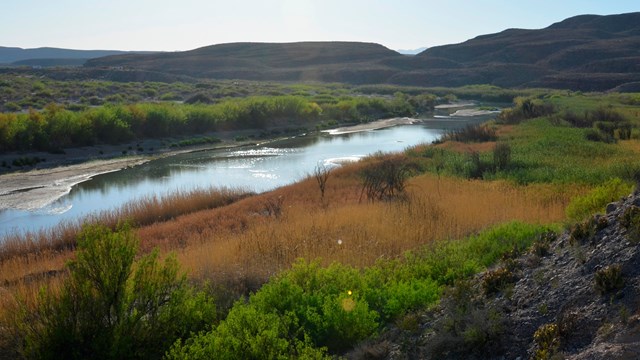
The Rio Grande flows from its headwaters in the San Juan Mountains of southern Colorado for 1,865 miles to the Gulf of Mexico near Brownsville, Texas. For 1,250 miles, the Rio Grande is the boundary between the United States and Mexico. In a remote stretch in west Texas, the river makes a curve to the northeast to form the “big bend.” It is here that the wild character of the river lives on.
more...
 
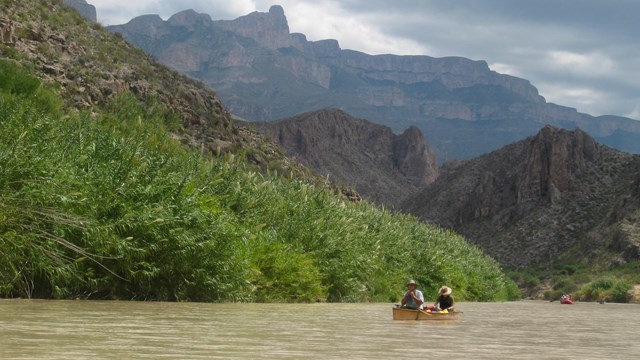
The Rio Grande above Boquillas Canyon

Planning a float trip

Remote, rugged, and surrounded by the often-unforgiving Chihuahuan Desert environment, the Rio Grande is a largely overlooked resource for modern-day adventurers seeking solitude. Plan ahead to ensure that you explore safely and enjoy the enchanting canyons and open-water vistas of the Rio Grande.
more...
 
Mariscal Canyon

Mariscal Canyon

A 10 mile, one day trip begins at Talley and ends at Solis Landing. Access to the put-in is rough and not recommended for ordinary automobile traffic. Consult a Park Ranger about road conditions before you finalize plans. Mariscal Canyon, six miles long with walls exceeding 1,400 feet, is spectacular. The rapids in the canyon are Class II-III.
more...
 
Boquillas Canyon

Boquillas Canyon

A 33 mile, two to three day trip begins at Rio Grande Village and ends at Heath Canyon, Texas (downstream from La Linda, Mexico). Boquillas Canyon is the longest canyon trip in Big Bend National Park, and its walls rise 1,200 feet above the river. Since no rapids rate higher than Class II, this is an ideal trip for those with less experience. Strong headwinds are common.
more...
 
Floating the Lower Canyons

The Lower Canyons

A five to ten day float trip, the journey through the Lower Canyons offers a true wilderness experience. The trip begins at Heath Canyon and ends at either Dryden Crossing (83 miles) or Foster’s Ranch (119 miles), which is at the end of the Rio Grande Wild and Scenic River. Some river runners continue to Langtry (137 miles).
more...
 

Write to

Rio Grande Wild & Scenic River c/o Big Bend National Park
PO Box 129
Big Bend National Park, TX 79834

Phone

Visitor Information
(432) 477-2251

Weather Information Hotline
(432) 477-1183

Fax

(432) 477-1175

Climate

Sunshine is abundant year-round on the Rio Grande. While this sounds welcoming, heat stroke and heat exhaustion are dangers to guard against during the hot months. Conversely, hypothermia is a life-threatening danger during the balance of the year. Infrequent and brief periods of cloudy weather are confined mostly to the winter months. Appropriate clothing and other gear should be carried from November through April as cold fronts can bring freezing weather with rain or snow. The "rainy season" extends from mid-July through early October and can result in locally heavy thunderstorms and flash floods. Rapid river rises can be dangerous if unprepared. Relative humidity is normally between 25% - 40% year around.
more...
Skip to SearchSkip to NavigationSkip to BodySkip to Footer
Mariscal Canyon  

Did You Know?
Mariscal Canyon on the Rio Grande Wild & Scenic River can be floated as an overnight trip; often the most difficult part is the drive to the Talley put-in along the primitive River Road.
more...

Last Updated: August 23, 2007 at 10:38 EST